Kennel Club
Kennel Club looks at the repositories your fleet serves and says which of them could hurt the fleet or stop its CI. It answers one question about each repository, and a check that cannot answer it does not belong here:
Does this affect running CI, or the fleet that runs it?
So it is not a linter, and it has no opinion about your code. It says that a public repository's jobs run on a pool a stranger's pull request could damage, and that jobs have been waiting ten minutes for a label no pool serves.
One optional area bends that rule, and says so: the setup checks report what a repository lacks that makes it harder to maintain, such as a README or a security policy. They are off until you turn them on, and informational when they are on. See the optional checks.
It is off by default, and off means off: nothing is read from GitHub,
nothing is stored, and AI Context carries on exactly as it was.
Turn it on with the Check repository standards setting
(kennel.enabled, see Configuration), and it appears in the
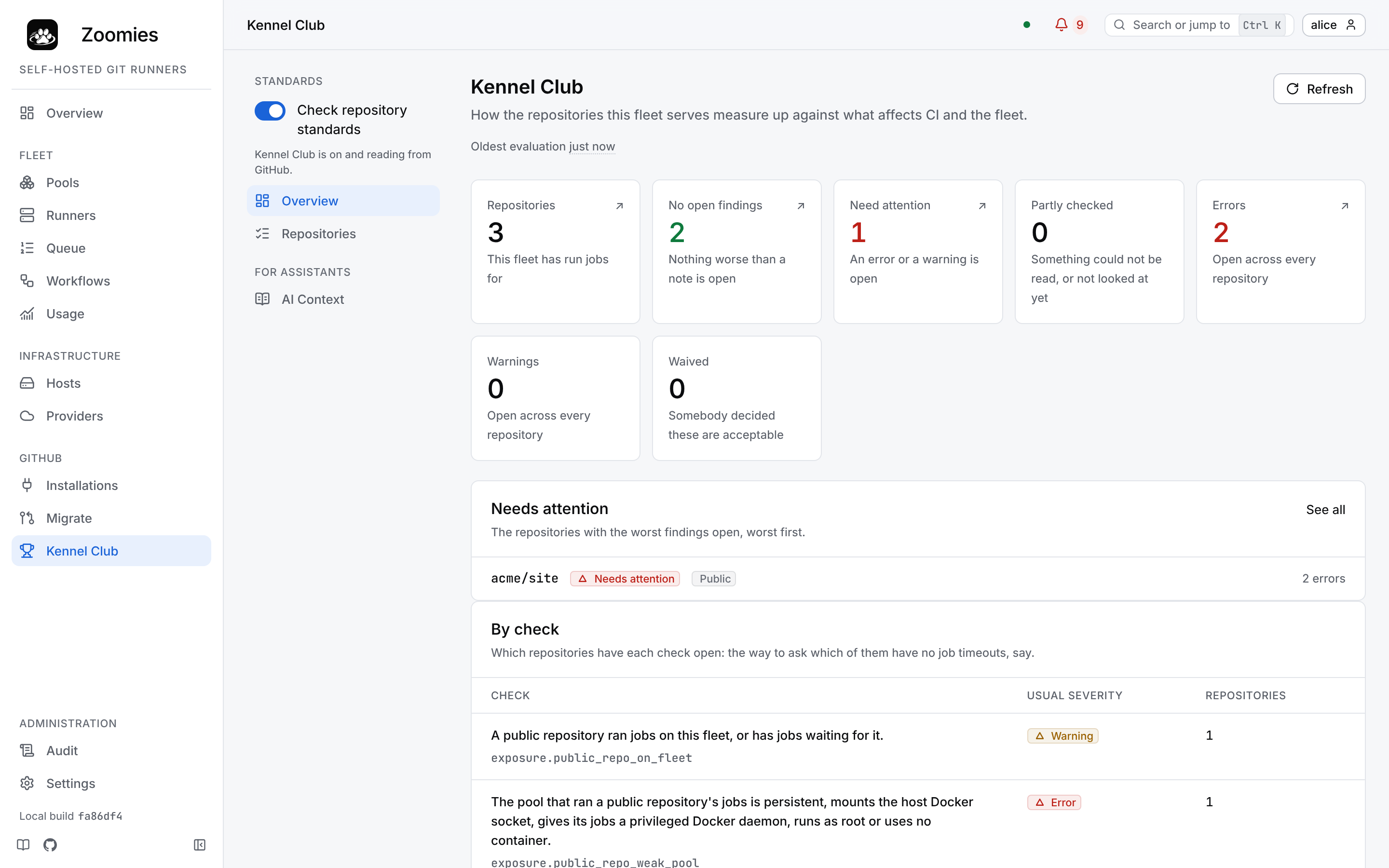
UI under Kennel Club. This is its Overview for the demo fleet:
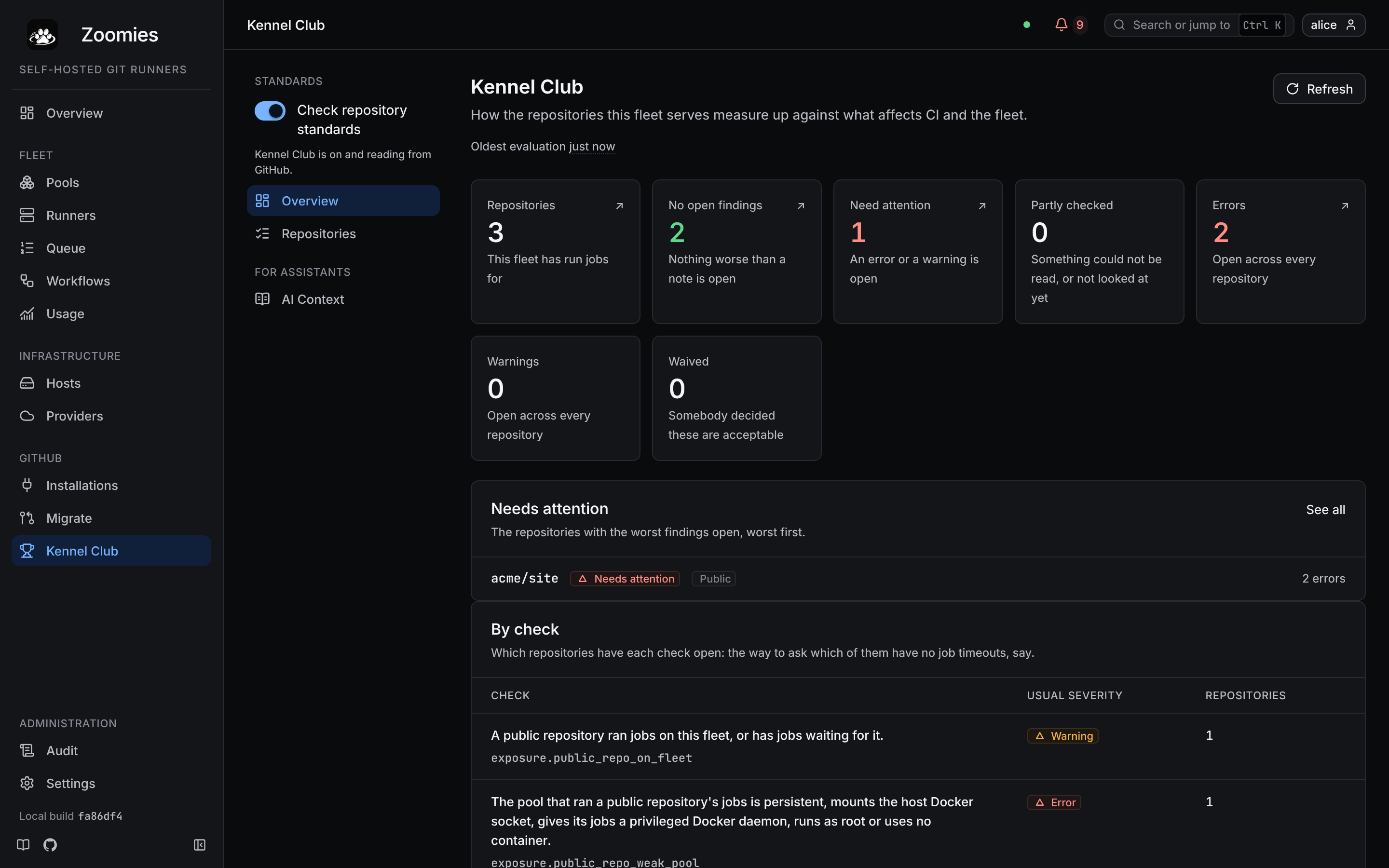
What it checks
There are twenty checks, in five areas. Six of them, in exposure and
capacity, run whenever Kennel Club is on; the other fourteen are opt-in,
and the switches that turn them on are described after
them. Each has a stable code, so a waiver, a metric or a disabled_checks
entry keeps meaning the same thing from one release to the next, and the same
codes are published with every problem code in
catalog.json and served by a running
controller at GET /api/v1/catalog, each with what to change and how to see
that it worked.
The list below is generated from the registry the evaluator runs by
make generate, so it cannot disagree with what a repository's page shows,
and a test fails the build when a check is added without it being run.
exposure.public_repo_on_fleet
- Area
- exposure
- Severity
- warning
- Detects
- A public repository ran jobs on this fleet, or has jobs waiting for it.
- Fix
- Decide whether this fleet should run a public repository's jobs at all; if it should, keep them on an ephemeral pool with no host socket, no privileged daemon and no root, so a stranger's pull request cannot reach the host.
- Verify
- Press Recheck once the pool is ephemeral and unprivileged, or once the repository no longer sends jobs here; the finding closes when the next read sees neither.
exposure.public_repo_weak_pool
- Area
- exposure
- Severity
- error
- Detects
- The pool that ran a public repository's jobs is persistent, mounts the host Docker socket, gives its jobs a privileged Docker daemon, runs as root or uses no container.
- Fix
- Move the public repository's jobs to a pool that is ephemeral, does not mount the host Docker socket, runs no privileged daemon and does not run as root, or make this pool so.
- Verify
- Press Recheck after the pool's settings change; the finding closes when every run of the repository in the window landed on a pool without those settings.
exposure.fork_code_ran
- Area
- exposure
- Severity
- error
- Detects
- A run from a fork's pull request executed on this fleet.
- Fix
- Require approval for workflows from fork pull requests in the repository's Actions settings, or stop routing its pull-request jobs to this fleet.
- Verify
- Press Recheck after the setting changes; the finding closes once no run from a fork's pull request has executed here in the window.
exposure.target_event_ran
- Area
- exposure
- Severity
- warning
- Detects
- A workflow that strangers can trigger (pull_request_target, workflow_run, issue_comment, issues) ran on this fleet in a public repository.
- Fix
- Read the workflows these events trigger and make sure none of them checks out or executes the pull request's own code; if one must, run it on an isolated, ephemeral pool.
- Verify
- Press Recheck once the workflow has been reviewed or moved; the finding closes when no run for those events has executed here in the window.
capacity.unserved_label
- Area
- capacity
- Severity
- warning
- Detects
- Jobs waited more than ten minutes for a label no pool serves.
- Fix
- Add the label to a pool that can run the job, or change the workflow's runs-on to a label a pool serves.
- Verify
- Press Recheck after the pool or the workflow changes; the finding closes once no job has waited ten minutes for an unserved label in the last seven days.
capacity.job_hit_default_limit
- Area
- capacity
- Severity
- warning
- Detects
- A job ran until GitHub stopped it at its six-hour default limit.
- Fix
- Set timeout-minutes on the job from its own usual duration, so a hung run is stopped in minutes rather than hours.
- Verify
- Press Recheck after the next run of the job; the finding closes once no run in the window was cancelled at the six-hour limit.
setup.readme
- Area
- setup
- Severity
- info
- Detects
- No repository-local README was found on the default branch.
- Fix
- Add a README with the project purpose, prerequisites and the commands to build, test and run it.
- Verify
- Press Recheck once the file is on the default branch; the finding closes when the next tree read finds it.
setup.licence
- Area
- setup
- Severity
- info
- Detects
- No repository-local licence was found on the default branch.
- Fix
- Choose an appropriate licence with the project owner and record it in a root licence file.
- Verify
- Press Recheck once the file is on the default branch; the finding closes when the next tree read finds it.
setup.security
- Area
- setup
- Severity
- info
- Detects
- No repository-local security policy was found on the default branch.
- Fix
- Add SECURITY.md with a private reporting route and supported versions, or confirm that the account default provides them.
- Verify
- Press Recheck once the file is on the default branch; the finding closes when the next tree read finds it.
setup.contributing
- Area
- setup
- Severity
- info
- Detects
- No repository-local contribution guide was found on the default branch.
- Fix
- Add CONTRIBUTING.md with setup, test and pull request guidance, or confirm that the account default provides it.
- Verify
- Press Recheck once the file is on the default branch; the finding closes when the next tree read finds it.
setup.code_of_conduct
- Area
- setup
- Severity
- info
- Detects
- No repository-local code of conduct was found on the default branch.
- Fix
- Add CODE_OF_CONDUCT.md with an enforcement contact, or confirm that the account default provides it.
- Verify
- Press Recheck once the file is on the default branch; the finding closes when the next tree read finds it.
setup.issue_template
- Area
- setup
- Severity
- info
- Detects
- No repository-local issue template was found on the default branch.
- Fix
- Add an issue form or template under .github/ISSUE_TEMPLATE, or confirm that account defaults provide one.
- Verify
- Press Recheck once the file is on the default branch; the finding closes when the next tree read finds it.
setup.pull_request_template
- Area
- setup
- Severity
- info
- Detects
- No repository-local pull request template was found on the default branch.
- Fix
- Add a pull request template with a change summary and validation prompts, or confirm that the account default provides one.
- Verify
- Press Recheck once the file is on the default branch; the finding closes when the next tree read finds it.
setup.codeowners
- Area
- setup
- Severity
- info
- Detects
- No repository-local CODEOWNERS file was found on the default branch.
- Fix
- Add CODEOWNERS in .github, the repository root or docs and assign owners for the CI workflows; review enforcement separately.
- Verify
- Press Recheck once the file is on the default branch; the finding closes when the next tree read finds it.
setup.dependency_updates
- Area
- setup
- Severity
- info
- Detects
- No repository-local dependency update configuration was found on the default branch.
- Fix
- Configure Dependabot or Renovate for the package ecosystems and GitHub Actions, or confirm that an external service manages updates.
- Verify
- Press Recheck once the file is on the default branch; the finding closes when the next tree read finds it.
setup.workflows
- Area
- setup
- Severity
- info
- Detects
- No repository-local CI workflow was found on the default branch.
- Fix
- Add a workflow under .github/workflows that runs the relevant build and tests, or confirm that CI is provided elsewhere.
- Verify
- Press Recheck once the file is on the default branch; the finding closes when the next tree read finds it.
ci.no_timeout
- Area
- ci
- Severity
- warning
- Detects
- Executable jobs have no timeout-minutes.
- Fix
- Set timeout-minutes on each executable job in the default-branch workflows, from its usual duration with a margin for a slow run.
- Verify
- Press Recheck after the change reaches the default branch; the finding closes when every executable job declares a timeout.
ci.no_concurrency
- Area
- ci
- Severity
- info
- Detects
- Pull-request-only workflows do not cancel superseded runs at workflow or job level.
- Fix
- Where a superseded pull-request run may be cancelled, add a concurrency group scoped to the workflow and the pull request with cancel-in-progress on.
- Verify
- Press Recheck after the change reaches the default branch; the finding closes when every pull-request-only workflow cancels superseded runs.
ci.action_not_pinned
- Area
- ci
- Severity
- warning
- Detects
- External actions or reusable workflows use mutable refs, or Docker actions use no image digest.
- Fix
- Pin every external action and reusable workflow to a reviewed full commit, and every Docker action to an image digest, and let an updater move the pins.
- Verify
- Press Recheck after the change reaches the default branch; the finding closes when no external reference is a tag or a branch.
token.permissions_unset
- Area
- token
- Severity
- warning
- Detects
- Jobs inherit token permissions without a declaration at workflow or job level.
- Fix
- Declare the least permissions each workflow or job needs, after reading what its actions and publishing steps use.
- Verify
- Press Recheck after the change reaches the default branch; the finding closes when every job has a permissions block of its own or its workflow's.
Exposure is about strangers. Code from outside your project should never run on a machine that keeps state between jobs, can reach the host's Docker daemon, or sits somewhere you would mind losing. A public repository on a self-hosted runner is the textbook way to hand a stranger a shell on your network, which is why the weak-pool and fork checks are errors and the softer two are warnings.
Capacity is about the fleet failing the people who use it. A job waiting for a label no pool serves will wait for ever, and a job that runs for six hours is usually stuck and not slow. Neither is a security problem, and both stop CI.
Each finding is written for the repository it is about: what is wrong, what to change, the pools and runs involved, and where to look. The sentences come from Kennel Club and never from the repository, so a pull request title or a branch name cannot put words into an operator's page.
The whole registry, all twenty, is served by GET /api/v1/kennel/checks, so a
script can read what is checked without scraping this page.
One finding can be worse than its usual severity. On its own,
exposure.public_repo_on_fleet is a warning: a public repository using your
fleet is a fact to know, and often a deliberate one. When
exposure.public_repo_weak_pool or exposure.fork_code_ran is open beside it,
it is raised to an error, because a stranger can already reach something
that matters. The raising happens before waivers are applied, so a waiver of the
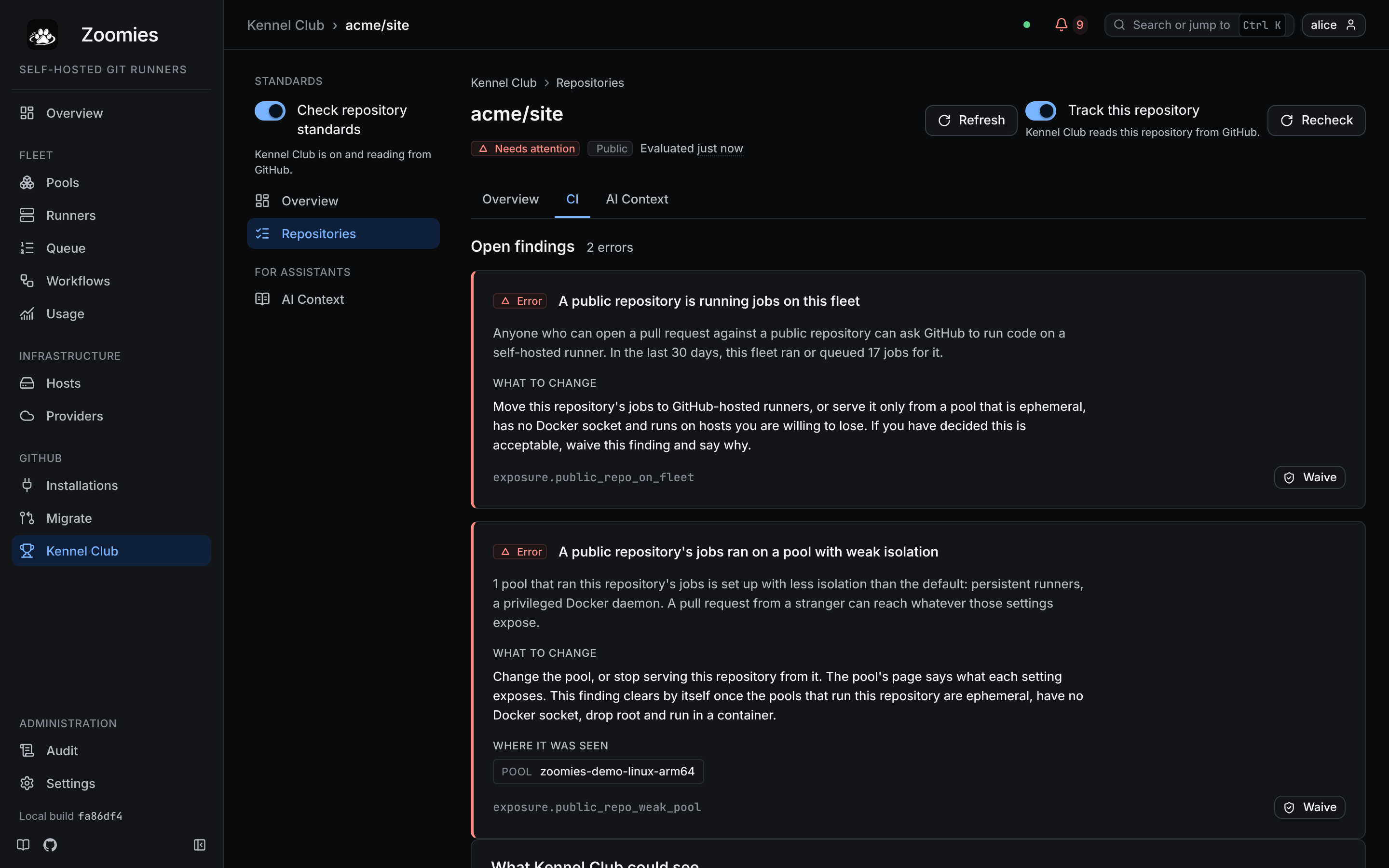
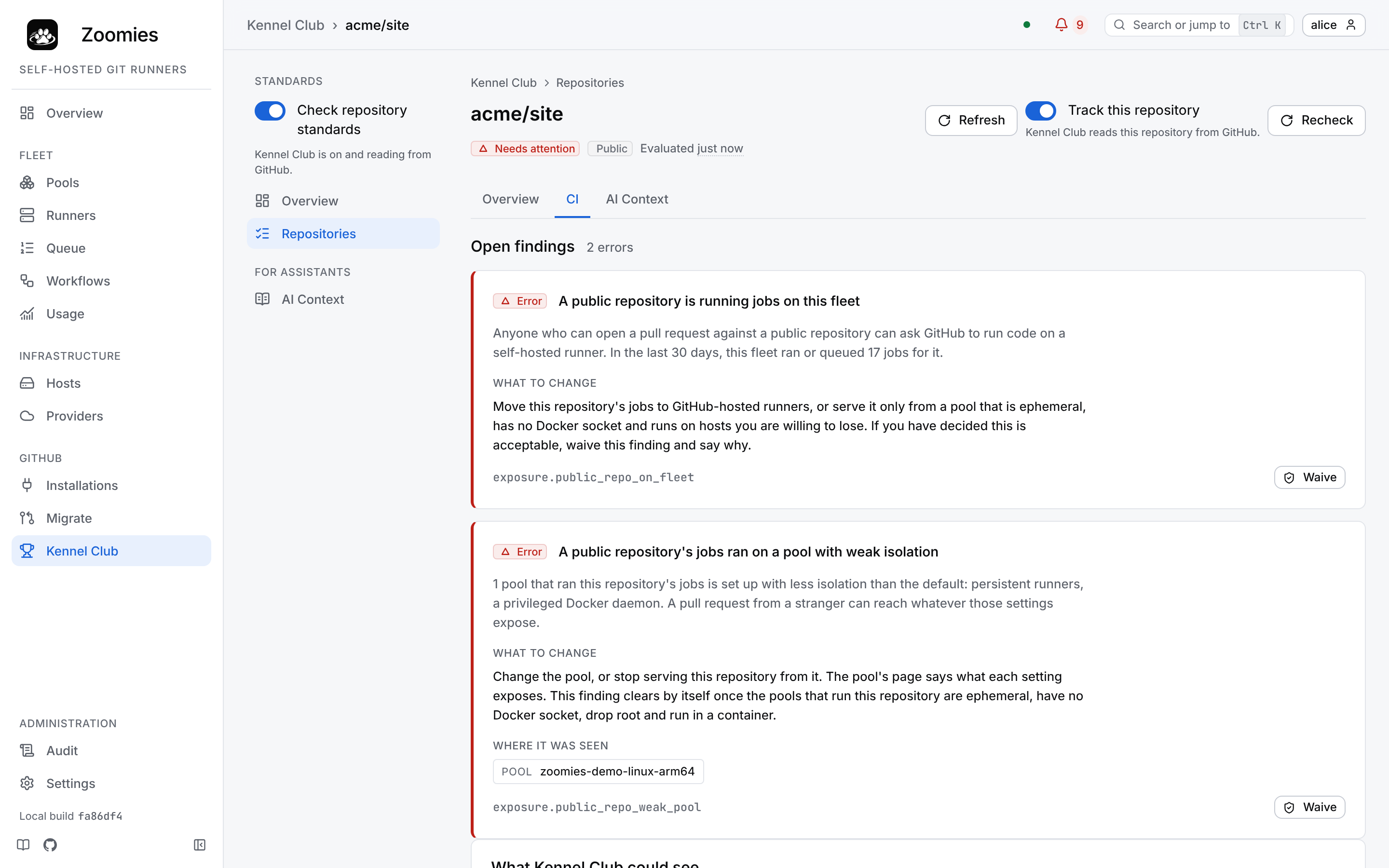
milder finding does not quietly cover the worse one. On acme/site the first
finding below is an error because the second is open beside it, and each says
what to change:
The optional checks
Fourteen checks read what is in a repository. Each group has a switch of its own and is off by default. Until a switch is on, its checks are shown as Turned off on the Overview, and nothing is read for them.
| Area | Checks | Turned on by | What it reads | What a finding is |
|---|---|---|---|---|
setup |
10: a README, a licence, a security policy, a contribution guide, a code of conduct, issue and pull request templates, CODEOWNERS, dependency updates and a CI workflow |
kennel.repository_setup (Check repository setup) |
The default branch's file names, as one Git tree request for each repository. No file contents. | Informational. It never lowers a repository's standing. |
ci |
3: ci.no_timeout, ci.no_concurrency, ci.action_not_pinned |
kennel.workflow_checks (Check workflow best practices) |
The default branch's workflow files. | A warning, except ci.no_concurrency, which is a note, as is ci.action_not_pinned when only GitHub's own actions are affected. |
token |
1: token.permissions_unset |
the same switch | The same files. | A warning for a public repository, a note for a private one. |
A setup finding says repository-local, because an account's default guidance may stand in for a file the repository does not have, and a missing file is advice, not proof. Empty files and symlinks do not count as present. A tree GitHub truncates leaves the repository partly checked and produces no "missing" finding, and so does a workflow file that is too large or too odd to read: findings from the files that were read stay, but the repository cannot earn an all clear. Configuration lists each setup check and what its absence makes harder, and the workflow checks say what each detects and what is excluded.
How to read a repository's standing
Every repository is in one of four standings, and the badge never says more than it knows.
flowchart TD
    A[Evaluated?] -->|not yet| P[Pending]
    A -->|yes| B{An error or a<br/>warning open?}
    B -->|yes| N[Needs attention]
    B -->|no| C{Every enabled check<br/>ran against<br/>everything it needs?}
    C -->|no| Q[Partly checked]
C -->|yes| G[Best in show]| Standing | Plain words (Status style Off) | Means |
|---|---|---|
| Best in show | No open findings | Every check that is turned on ran against everything it needs, and nothing worse than a note is open. |
| Needs attention | Needs attention | An error or a warning is open. It outranks Partly checked, so an open error is never hidden behind "we could not read everything". |
| Partly checked | Partly checked | Nothing is open, but something could not be read, so this is not an all clear. |
| Pending | Pending | Kennel Club has not looked at the repository yet. |
Best in show is a playful name for a serious claim, and it is earned the hard way. A repository that could not be fully read is not the best of anything, a repository with every check turned off is never given the badge, and a finding that is only a note does not take it away. A waived finding does not take it away either, but it is never hidden: the Overview counts the waived findings beside the badge.
The dog-park name is the Status style in Settings → Appearance: with it on Cute or Standard the badge says Best in show, and with it Off, which is where a browser that has never chosen starts, it says No open findings. What it means is the same either way.
One more thing looks like a standing and is not one: Not tracked means somebody told Kennel Club not to look at the repository. See Stopping Kennel Club looking at a repository.
What it reads
Every check names the facts it needs, and a check whose facts cannot be read is skipped and says why. It is never judged against half the picture.
| Source | What it is | Permission it needs |
|---|---|---|
| What this fleet observed | Which pool ran a job, which label nothing served, how long a job ran. Already in Zoomies' database. | None. It costs no GitHub request and is always readable. |
| Repository details | The repository's own record, above all whether it is public. | Repository permissions: Metadata: Read-only |
| Workflow runs | What triggered the runs this fleet ran, and which repository they came from. Read for public repositories only. | Repository permissions: Actions: Read-only |
| Repository setup files | The default branch's file names. Read only when kennel.repository_setup is on. |
Repository permissions: Contents: Read-only, needed for private repositories |
| Workflow best practices | The default branch's workflow files, read for timeouts, concurrency, action pins and token permissions. Read only when kennel.workflow_checks is on. |
Repository permissions: Contents: Read-only, needed for private repositories |
A source can be in one of these states, and the Kennel Club page shows it beside the repository it affects:
- Read in full. The usual case.
- Partly read. A page cap was reached, or the read was a sample. A finding found in a partial read stands, but finding nothing is not an all clear.
- Not permitted. GitHub refused for want of a permission the installation has not been given. The page names the permission. If you chose not to grant it, that is a choice and not a fault, so it is shown on the repositories it affects and does not become a problem.
- Not available. This GitHub does not offer it, or the repository does not have it. Never a finding.
- Held back. Reads are paused for this installation, either because GitHub rate-limited it or because Kennel Club has spent what its budget allows this hour.
- Failed. A transient failure, tried again at the next refresh.
A private repository costs no read beyond the repository listing Zoomies already makes, because the checks that need run history are about public repositories. The two opt-in sources are the exception: with either on, a private repository's tree is read too, which is why they ask for Contents.
Every GitHub request it may make
The reader is held to a list, and a test runs it against a fake GitHub and fails
on any request that is not on the list, so a new call is a visible change in
review and not something found in a log. All of them are GETs, and the last two
are made only when one of the opt-in switches is on.
| Request | What for |
|---|---|
GET /installation/repositories |
The repositories the App can see, which Zoomies already lists. A refresh GitHub answers "not modified" costs nothing against the rate limit. |
GET /repos/{owner}/{repo} |
One repository's own record: whether it is public. |
GET /repos/{owner}/{repo}/actions/runs/{run} |
One workflow run the fleet ran in a public repository. Four fields are read: the event that triggered it (held to a short allow-list before anything sees it), the repository it ran in, and the repository its head commit is in, which differ for a pull request from a fork, and the run's ID. Who triggered it, its branch, its title and its workflow's path are written by whoever opened the pull request, and are never read. |
GET /orgs/{org}/actions/runner-groups |
Whether the organisation runner group a pool joins allows public repositories, so a finding can say so. |
GET /rate_limit |
The limit the installation reports, which the budget is a share of. GitHub does not count this request against the limit. |
GET /repos/{owner}/{repo}/git/trees/{tree} |
The default branch's file names, one conditional request for each repository on each refresh, for the setup checks and to find the workflow files. Inspection stops at 10,000 entries, and a truncated tree produces no "missing" findings. |
GET /repos/{owner}/{repo}/git/blobs/{blob} |
One workflow file, pinned to the immutable blob the tree named. At most 50 files a refresh, each at most 256 KiB. The file is parsed and never executed, and what is kept is counts: no path, job name, expression or text. |
What it never does
- It reads and does not write. In this release Kennel Club makes no change to GitHub, to a pool, to a runner or to a job. A finding is advice.
- It reads no source code. It looks at who ran what, where, and how long a
job took. The only files it can read are the default branch's file names and
its workflow files, and only if you turned on
kennel.repository_setuporkennel.workflow_checks. AI Context is the part of Zoomies that reads source for assistants, and Kennel Club does not touch it, which is also why turning one off leaves the other alone. - It does not repeat a stranger's words. The text of a finding is written by the check, from a fixed set of sentences. Anything in a repository that a stranger could write, such as a branch name, a pull request title or a workflow name, is kept out of the sentences, and a test fails if one gets in.
- It does not starve scaling of GitHub requests. Registering runners and
scaling use the same rate limit. Kennel Club never starts a read for an
installation GitHub has rate-limited (the tree and file reads included), it
spends at most
kennel.api_budget_percent(5 to 50 per cent, 20 by default) of the limit that installation last reported, and it stops altogether when less than half of the limit is left. A read GitHub answers with "not modified" costs nothing against the limit, so a refresh that finds nothing changed is free.
Choosing what it looks at
kennel.scope says which repositories it checks:
served(the default) checks the repositories this fleet has run a job for. A repository nobody has used you for has nothing to say about your fleet.installationchecks the repositories the GitHub App can see, which also finds the ones that could send you a job but have not yet. It reads at most 500 repositories for each installation, so on a larger one the rest are never discovered, and Kennel Club says nothing about them. It also multiplies the requests Kennel Club makes, which is why it is a choice and not the default.
kennel.refresh_interval is how stale what Kennel Club read from GitHub may get
before it is read again. What your own fleet observed is not subject to it: that
is re-checked as the fleet changes, and costs GitHub nothing.
Turning a check or an area off
kennel.disabled_checks takes check codes (exposure.fork_code_ran) or whole
areas (exposure, capacity, setup, ci, token). Turning off every setup
check stops its file-name reads, and turning off both ci and token stops the
workflow reads. A misspelt name is refused when you save it,
because a name that matches nothing would leave running the check you meant to
turn off.
A check that is turned off is shown as turned off, not hidden, so nobody reads its silence as a clean bill of health. And a repository with every check turned off is never given the Best in show badge.
Waiving a finding
Some findings are decisions you have made. A repository that deliberately runs public jobs on a disposable pool has a finding for it, and you may be content with that. A waiver records the decision, instead of hiding the finding. Waive on a finding asks for the reason and for how long:
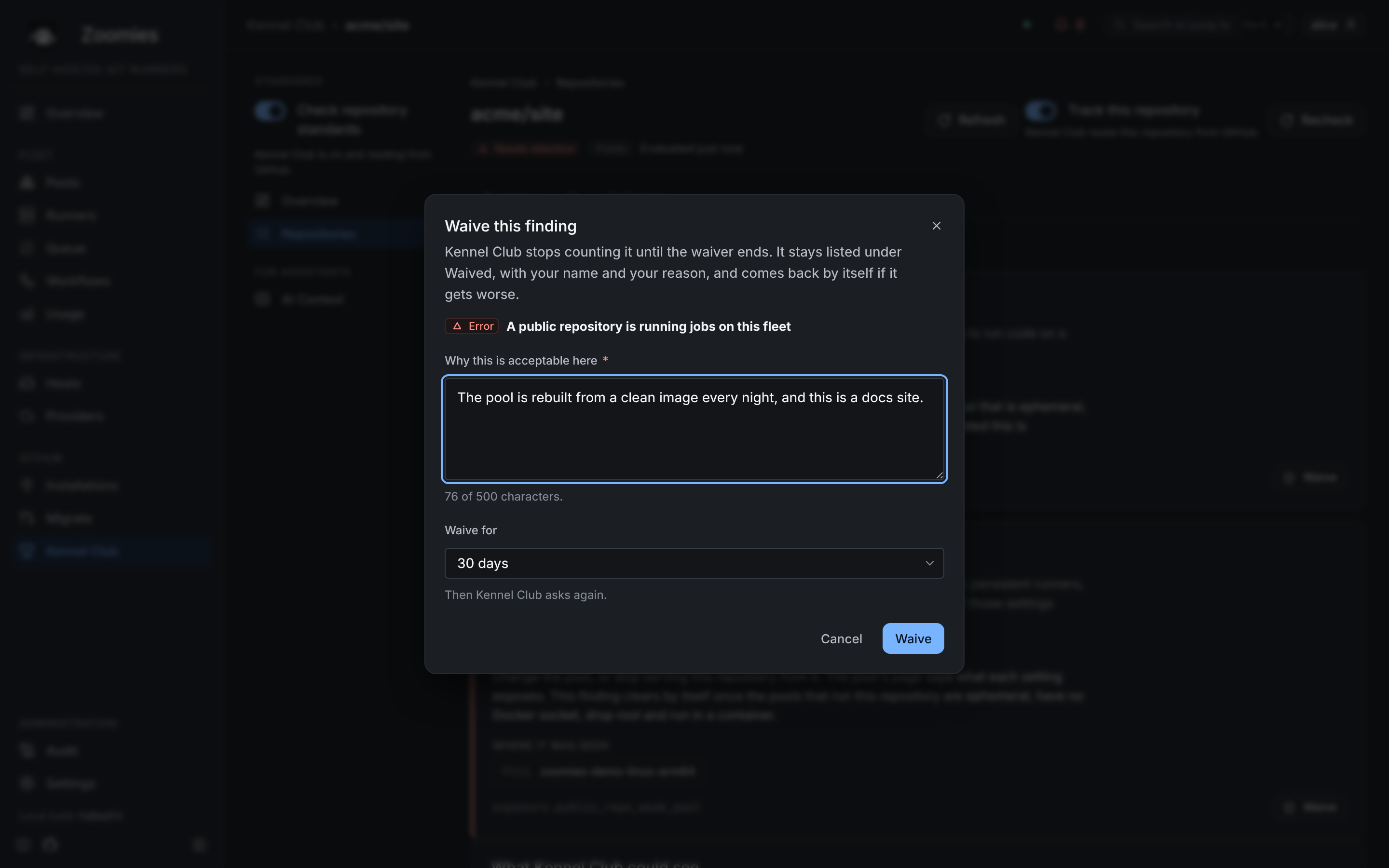
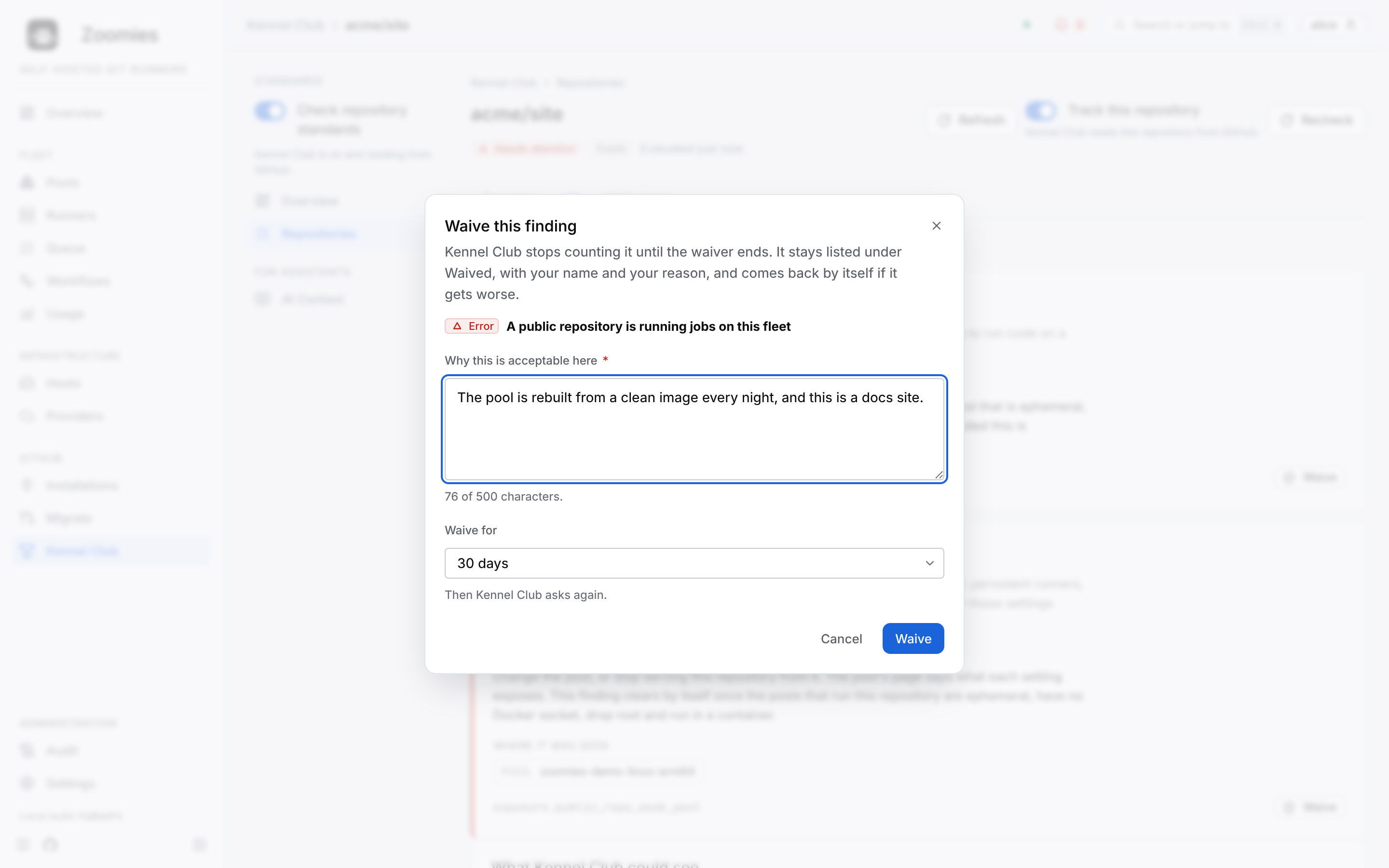
- It needs a reason, of at least ten and at most five hundred characters, because whoever reads the audit log in a year will want to know why.
- It needs an end, at most a year away. A decision nobody is asked to make again is how an exception becomes the rule.
- It names who decided, and it is in the audit log.
- It is never hidden. A waived finding is listed under Waived with who decided, why and until when, and the Overview counts it.
- It comes back by itself if it gets worse. A waiver covers the finding at the severity it had when it was made, so a warning waived last month does not excuse the error it has since become.
Waiving an error is an administrator's decision. An operator can waive a warning or a note. Any operator can end a waiver, since ending one only makes Kennel Club stricter.
Stopping Kennel Club looking at a repository
Every repository is tracked until somebody says otherwise. A scratch repository that runs public jobs on purpose, or one that is archived in all but name, can be told to be left alone. On the repository's page, Track this repository is a switch, and turning it off says what it will do before it does it:
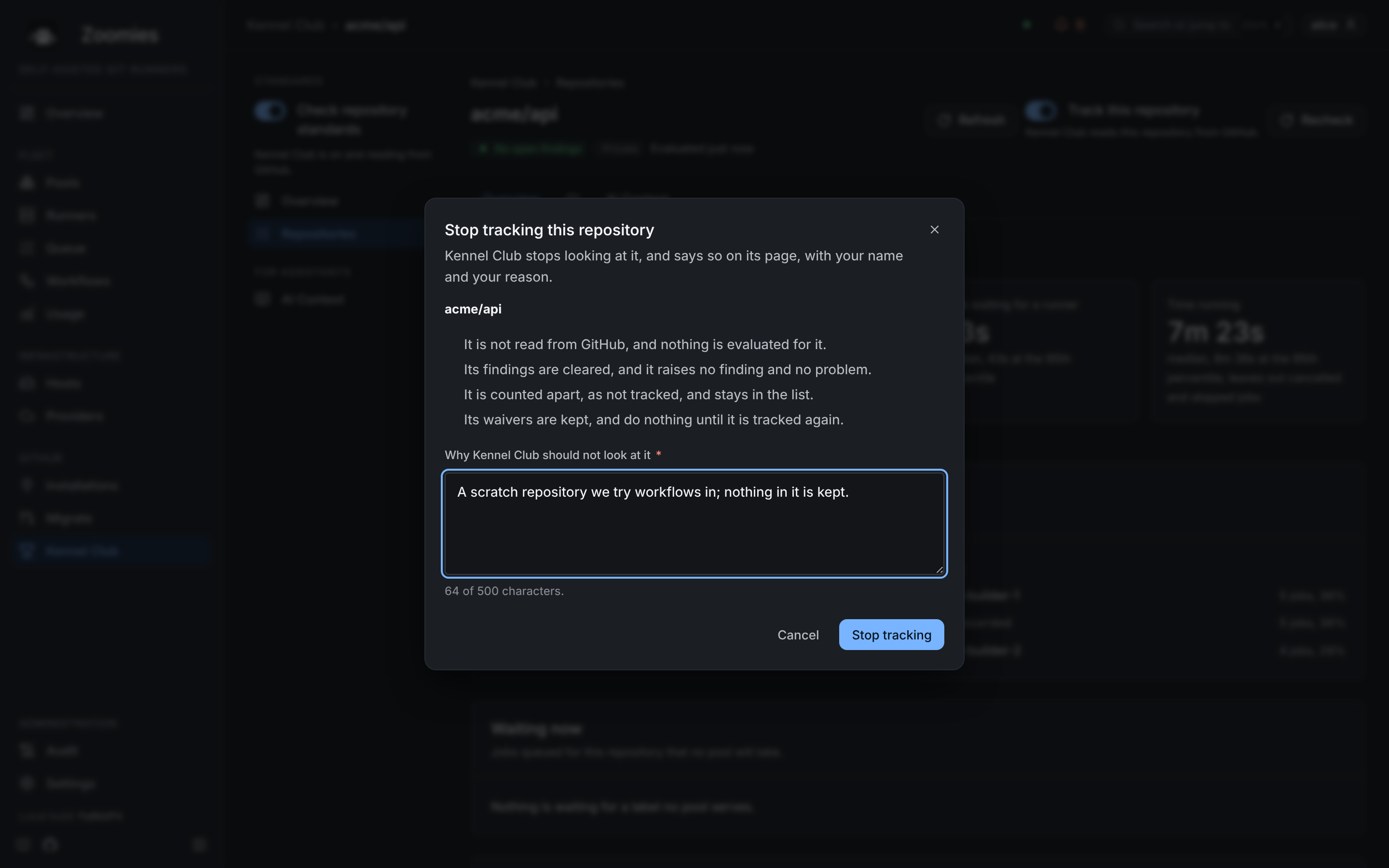
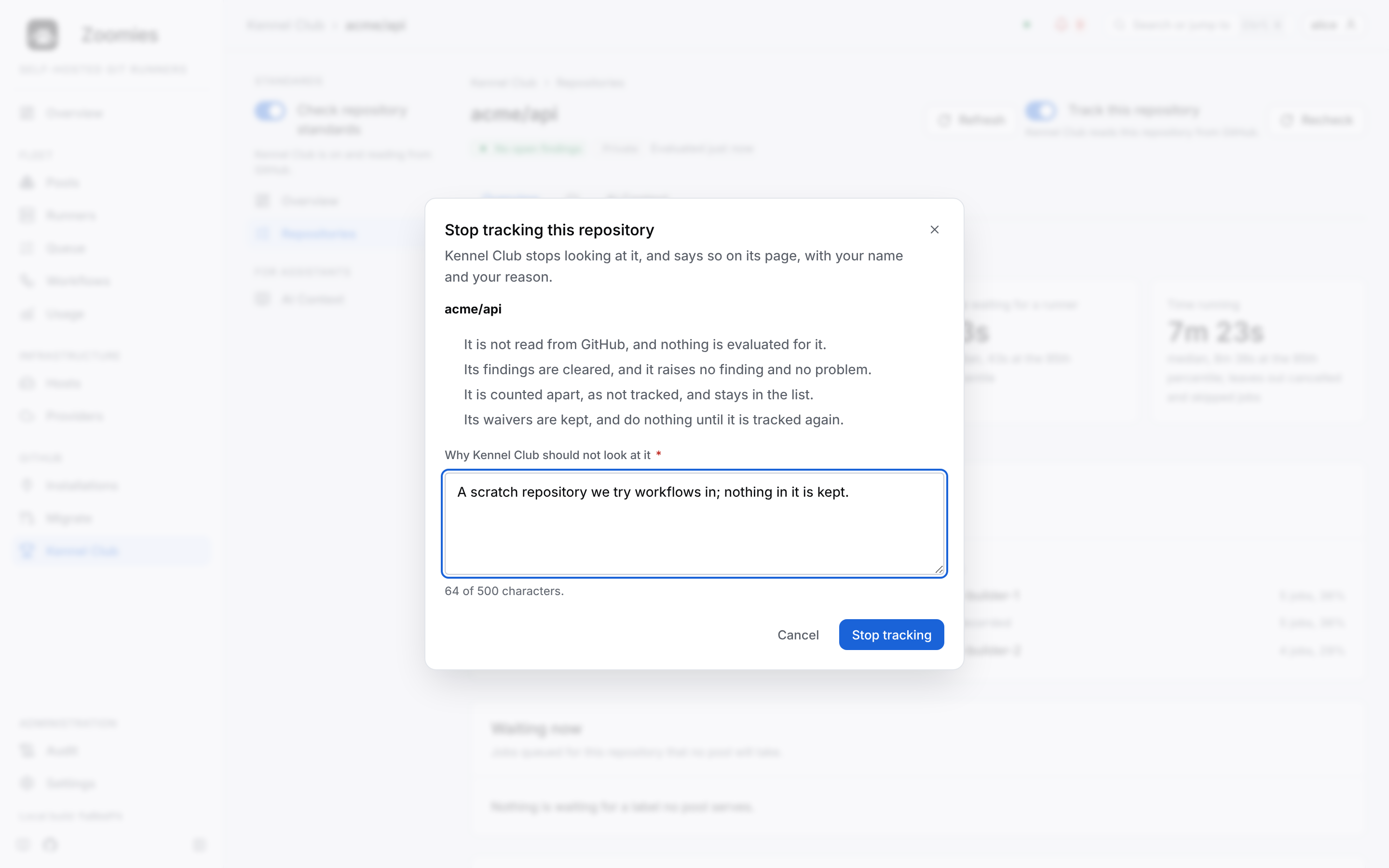
- An administrator stops it, and is asked for a reason first, in the same length a waiver's is held to: stopping silences the repository's errors, so whoever finds it quiet in a year will want to know why.
- An operator starts it again with one press and no reason, because that can only make Kennel Club stricter. Anybody else sees the state and who can change it, instead of a switch that would answer 403.
- A repository that is not tracked is not read and nothing is evaluated for it. It has no findings, raises no problem, is counted on the Overview as Not tracked and in no other number, and has no Recheck. Having no findings is not an all clear, and its page says so.
- Its waivers are kept and do nothing until it is tracked again.
- It is kept however long it has been quiet. A repository nobody has run a job for in ninety days is normally forgotten, but not one somebody chose to stop, so a sandbox does not come back tracked, and read, the day somebody pushes to it.
Afterwards the repository's page says who stopped it, when and why, and that it is not looking:
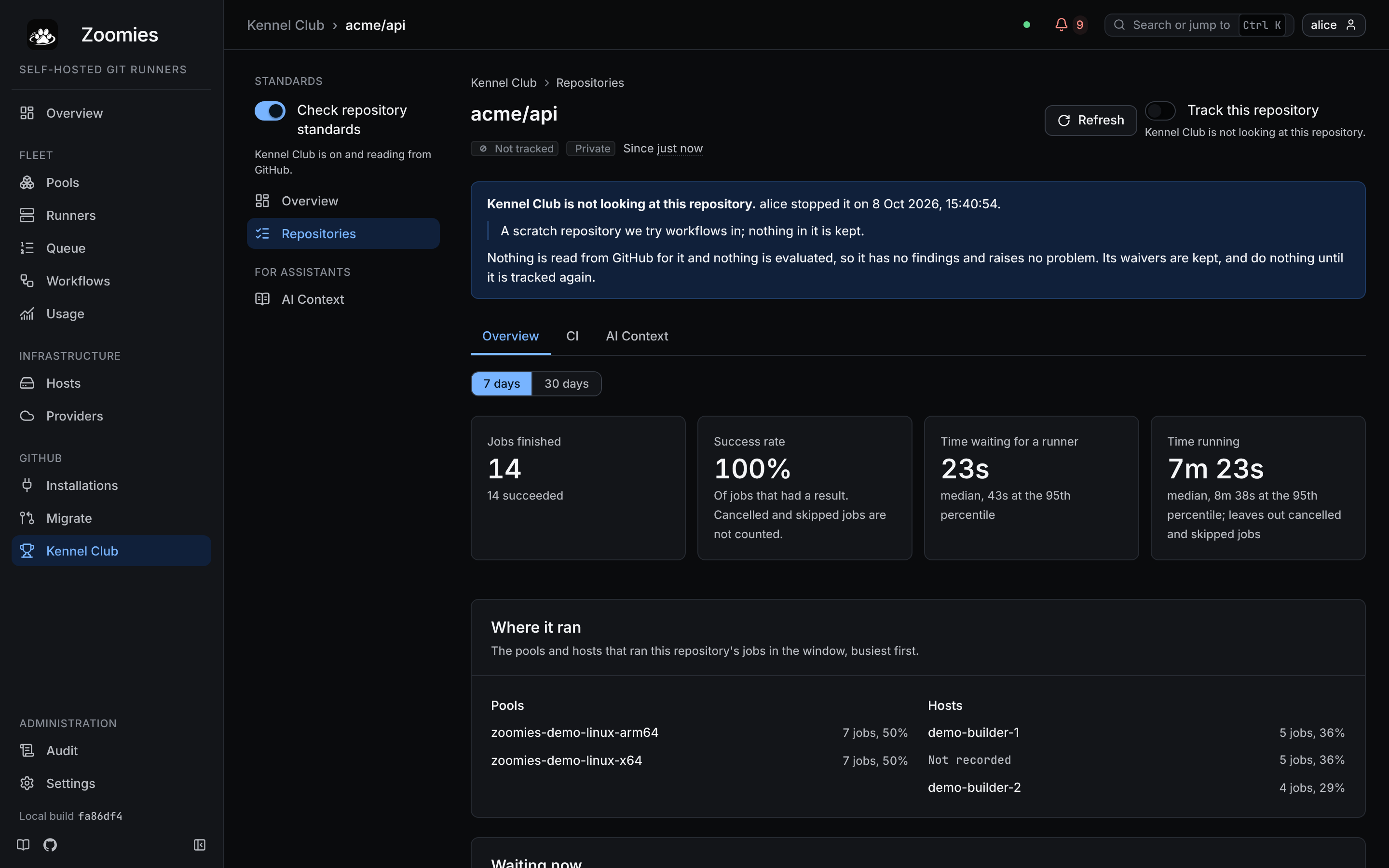
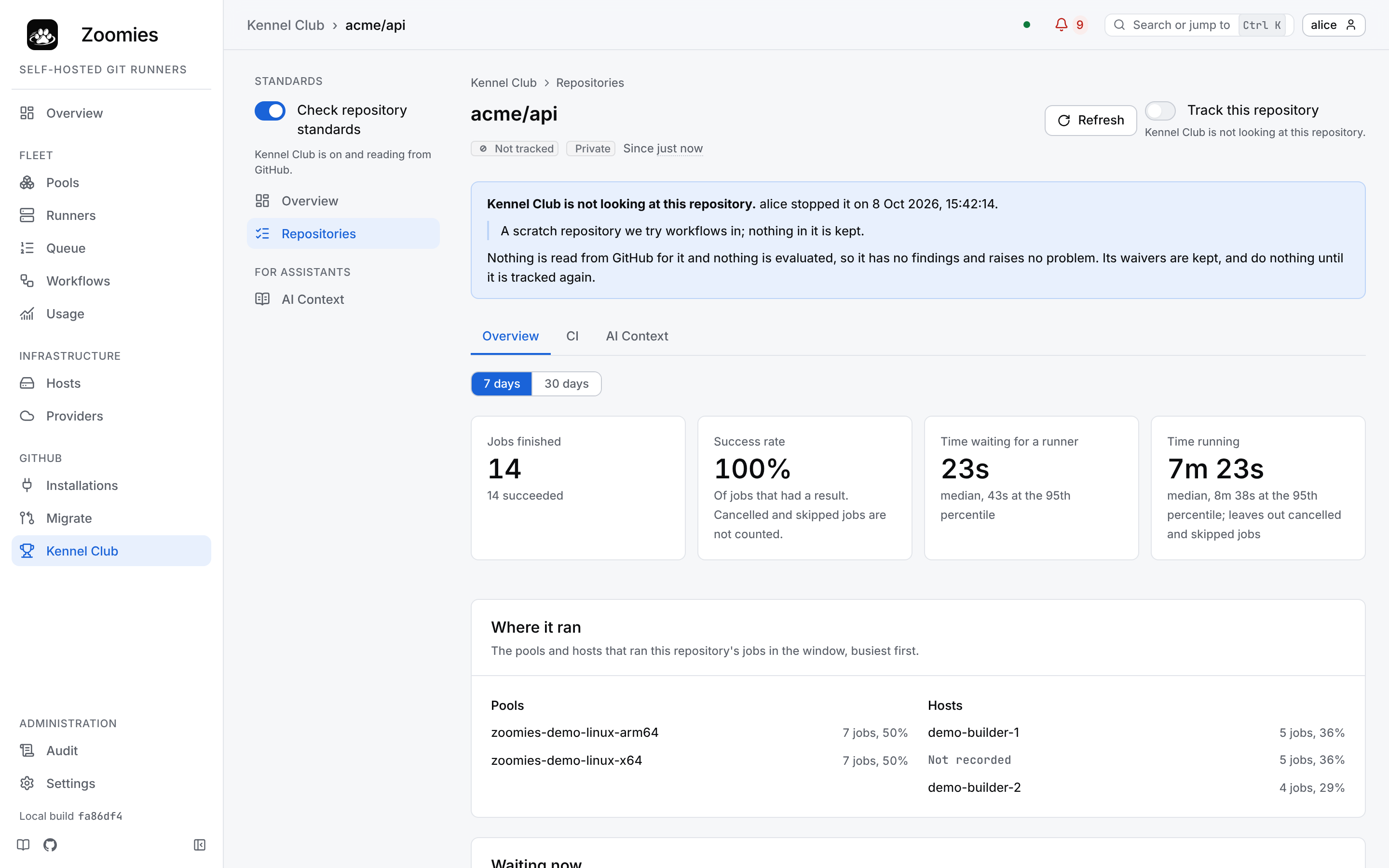
The repository list leaves untracked repositories out unless you ask for them, so that a card's number and the rows behind it agree. The Tracking filter brings them back.
Stopping several at once
A fleet that has a dozen sandboxes to leave alone does not have to open a dozen pages. On the Repositories list an administrator ticks the rows and presses Stop tracking in the bar that appears. The dialog names what is about to be stopped (eight names, then a count of the rest), asks for one reason in the same length as above, and says the same four things it says for one repository.
- Each repository is its own decision. The reason is written once and sent for each, so every repository has its own request and its own audit entry, naming the person who stopped it.
- The requests go one after another, in the order the rows were ticked, and not all together. A failure is then attributable: when one is refused the page names it, instead of saying that some were, and the audit log reads in the order the person chose.
- A repository that is already not tracked is left as it is, keeping the reason it was stopped with and the person who stopped it, so this is not a way to rewrite what a colleague wrote. The dialog says how many it is leaving, and if everything ticked was already stopped it says there is nothing to stop instead of asking for a reason to do nothing.
- What was refused stays ticked. If some could not be stopped, the page says how many, names them and says why, and the ones that did stop leave the list; the rest are still selected, so pressing the button again tries only those.
- A reason the controller refuses is said beside the field, and nothing has been stopped, because the same reason would be refused for every one of them.
Only an administrator is offered the tick boxes, since stopping is theirs. There is no bulk start: starting again is one press on a repository's own page, and nobody has asked for a hundred repositories to be made stricter at once.
Where it shows up
The Repositories list opens on the tracked repositories that have run a job in the last thirty days. Active on Zoomies widens it to every repository Kennel Club knows, a choice each person's browser remembers, and the Overview's cards open it widened, so that a number and the rows behind it agree:
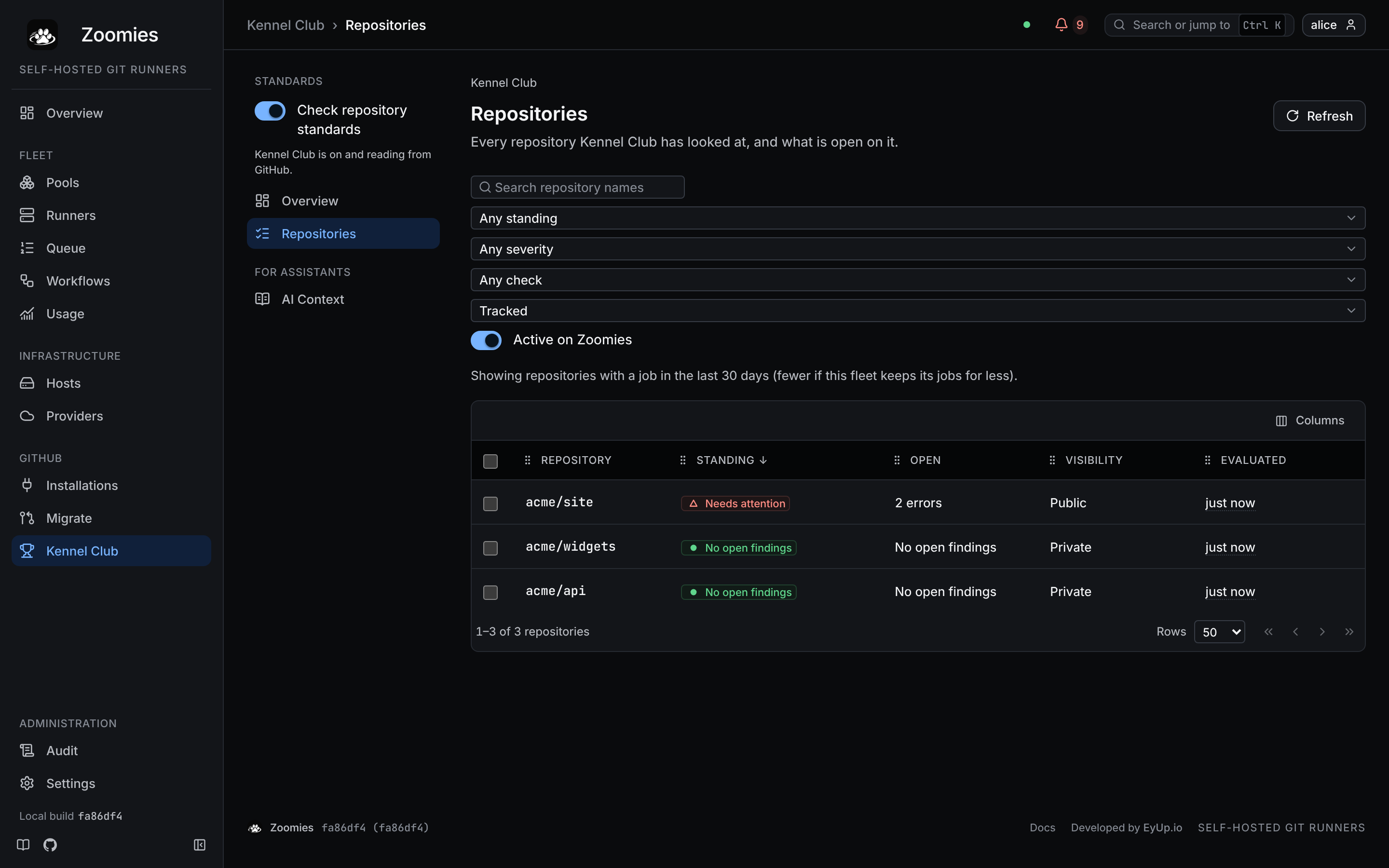

- The UI. Under Kennel Club in the side menu: the Overview (how many repositories are in each standing, what is open by severity, and which to open first), Repositories (the list, narrowed by standing, severity, check and tracking, every filter in the address so that a view is a link to send), and each repository's own page, with an Overview of what the fleet knows, a CI tab with Kennel Club's findings and a tab for its AI Context. See the UI, page by page for each page.
- Problems. Two kinds reach the problems list, and no others:
kennel.exposure, one problem for the fleet with the count of repositories that have an open, unwaived error in its title and none of them named, andkennel.unavailable, which says Kennel Club has been unable to read an installation for six hours. A warning on its own raises nothing: it appears in Kennel Club and nowhere else. See problem codes. - The API.
GET /api/v1/kenneland the routes beneath it, and three event kinds on the stream:kennel.updated,kennel.deletedandkennel.summary. See the API. - Assistants. The
kennel_overview,kennel_repositoryandkennel_findingstools, which read the same API and can do nothing the caller's token could not. See Connect Claude. - Metrics.
zoomies_kennel_*counters: findings opened, closed and waived by check, GitHub requests by outcome, and rate-limit holds. See metrics.
Roles
| Can | Role |
|---|---|
| Read everything above | viewer |
| Recheck a repository, waive a warning or a note, end a waiver, start tracking again | operator |
| Waive an error, stop tracking a repository | administrator |
Tokens carry the same split in scopes, so a token can be allowed to waive warnings without being allowed to waive errors.
Turning it off again
Set kennel.enabled back to false. It stops reading at once, and the stored
evaluations are kept, so turning it on again does not start from nothing. While
it is off the UI says so and shows nothing as if it were a verdict, and nothing
Kennel Club raised stays in the problems list.